
Eugene, Oregon
UO President Scholz: is one of the most effective approaches for local readers who need practical, source-backed guidance on this topic.
UO President Scholz announced on May 20, 2026 , that he is initiating a six-month dialogue with the UO Senate to address the university’s significant financial challenges . As an economist by training , the 6 feet 5 inches tall leader has described himself as an “incorrigible optimist ” despite the fiscal hurdles facing the institution . This period of open communication aims to find sustainable paths forward for the university during a time of economic instability .
Financial Dialogue with UO President Scholz
The decision to open a six-month dialogue was a direct response to the growing budget gaps at the University of Oregon . According to official remarks from the Office of the President, the goal is to be transparent about the university’s financial health and to collaborate with the Senate on potential solutions . This approach reflects the leadership style of UO President Scholz, who seeks to balance his economic expertise with a positive outlook for the campus community .
The State of Public Funding in Oregon
A major driver of the current crisis is the lack of state support . Oregon currently ranks 46th among all states in public support for four-year universities . The funding per full-time Oregon student stands at only $6,531 . When compared to neighboring states , the gap is stark:
- Idaho invests 58 percent more than Oregon per student .
- California and Nevada both invest more than 70 percent more .
- Washington invests 127 percent more , which is more than double the level of support provided in Oregon .
Budget Pressures and UO President Scholz
Beyond the lack of state funding , internal pressures have mounted . Oregon’s state-mandated benefits , specifically PERS and PEBB , are the 8th most expensive in the country , putting a heavy strain on the university’s operating budget . By June 2025 , UO President Scholz had already issued the first layoff notices to staff . In emails to the campus community , he warned that the university would be navigating “choppy financial waters ” for the foreseeable future .
Shifting Enrollment Trends
Enrollment patterns have also shifted in ways that impact the bottom line . For the past decade , the UO has averaged nearly 2,400 new non-resident undergraduate students each fall . However , the university expected fewer than 1,900 new non-resident students for the upcoming year , representing a drop of 500 students compared to the previous year . While this decrease in out-of-state tuition revenue is a concern , there is a silver lining: the university anticipates a class that will be near its historic high for in-state enrollment .
Campus Tensions and Protests
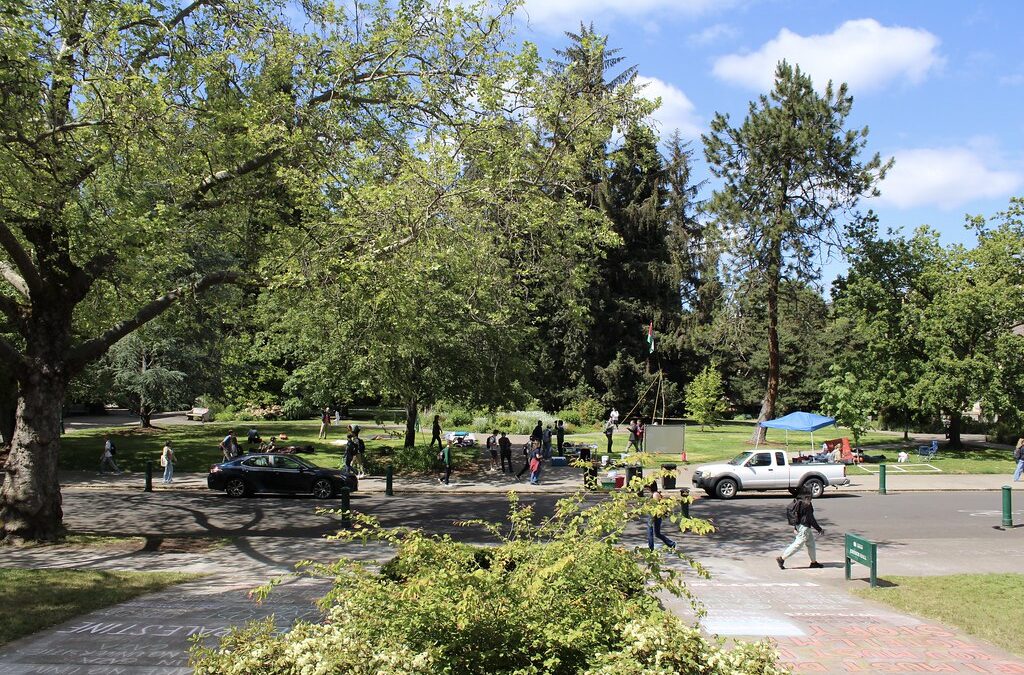
The financial stress has coincided with significant social and labor unrest . During 2024 , the investiture ceremony for UO President Scholz at Matthew Knight Arena was interrupted by pro-Palestine protestors who appeared with red-dyed hands . Similarly , his commencement address at Autzen Stadium was cut off by “Free Palestine ” chants . On the labor front , student workers staged a sit-in outside the office of the president in Johnson Hall during negotiations for a new contract , highlighting the tension between administration and the student workforce .
Strategic Moves and Institutional Growth
Despite these challenges , the university has made bold strategic moves . UO President Scholz played a key role in the decision for the University of Oregon to join the Big Ten Conference . This move is expected to increase the university’s national profile and athletic revenue , which complements the focus on the Oregon Ducks Football 2026 season and its impact on the local economy . However , some critics have pointed to the contrast between these growth initiatives and the budget cuts , noting that the president’s annual salary is $750,000 .
What’s Next for the University
The trajectory of the institution under UO President Scholz remains a balance between athletic expansion and academic austerity . As the university navigates its budget dialogue , the broader Eugene community continues to thrive with events like the Free Summer Concerts Eugene series , providing a cultural backdrop to the academic struggles downtown . The coming months will determine if the university can bridge the funding gap without further impacting its staff or students .